
There’s a practical decision to make when you weigh home window tinting against traditional window treatments for Pinal County homes; this overview helps you assess energy savings, privacy, maintenance, sunlight control and cost so you can choose the best option for your climate and lifestyle.
Overview of Home Window Tinting
Given Pinal County’s long, intense sun exposure, you benefit from window films that cut UV by up to 99% and reduce solar heat gain 30-60% depending on film choice. Many homeowners see lower glare, longer-lasting furnishings, and film lifespans of 10-15 years; contractors typically match film type to orientation, glass size, and your privacy needs.
Benefits of Window Tinting
You gain measurable energy savings-often reducing cooling load by up to 10-15% in hot climates-alongside UV protection, glare control, and increased glass safety. In practical terms, tinting can extend carpet and upholstery life, protect artwork, and provide daytime privacy without heavy treatments; installers commonly combine VLT and solar rejection specs to meet your comfort and code requirements.
- Blocks up to 99% of UV rays, protecting skin and fabrics.
- Reduces interior solar heat gain by roughly 30-60% depending on film.
- Cuts glare significantly, improving screen visibility and comfort.
- Often lowers summer cooling energy use by up to 10-15% in sun-exposed rooms.
- After installation, you typically notice immediate temperature stabilization and glare reduction.
| Benefit | Typical impact |
| UV protection | Up to 99% UV blocked |
| Solar heat rejection | ~30-60% reduction |
| Glare reduction | 50-90% depending on VLT |
| Energy savings | Cooling bills down ~10-15% |
| Privacy | Variable by film darkness/VLT |
Types of Window Tinting
You’ll encounter five main categories: dyed (budget privacy), metalized (reflective/heat control), hybrid (dyed + metal mix), ceramic (high-performance, non-metal), and safety/security films that add shatter resistance; each varies by visible light transmission (VLT), heat rejection, and interference with electronics.
Ceramic films often deliver the best balance for Pinal County: they reject high amounts of IR and heat without radio interference and maintain clearer optics. For example, a ceramic 20% VLT film can drop interior surface temperatures several degrees and still allow natural daylight. Conversely, dyed films cost less but may fade over 5-10 years; metalized films offer strong solar rejection but can affect signals, so choose based on which rooms you prioritize-south- and west-facing glass usually benefit most.
- Dyed: low cost, good for privacy and glare reduction.
- Metalized: strong reflectivity and heat rejection, may affect signals.
- Hybrid: balances cost and performance for common rooms.
- Ceramic: top-tier heat/IR rejection with minimal interference.
- After choosing a type, match VLT and warranty to your specific windows and orientation.
| Type | Best use |
| Dyed | Budget privacy, moderate glare control |
| Metalized | Maximum reflectivity, strong heat control |
| Hybrid | Balanced performance and cost |
| Ceramic | High performance, no RF interference |
| Safety/Security | Shatter resistance and added protection |
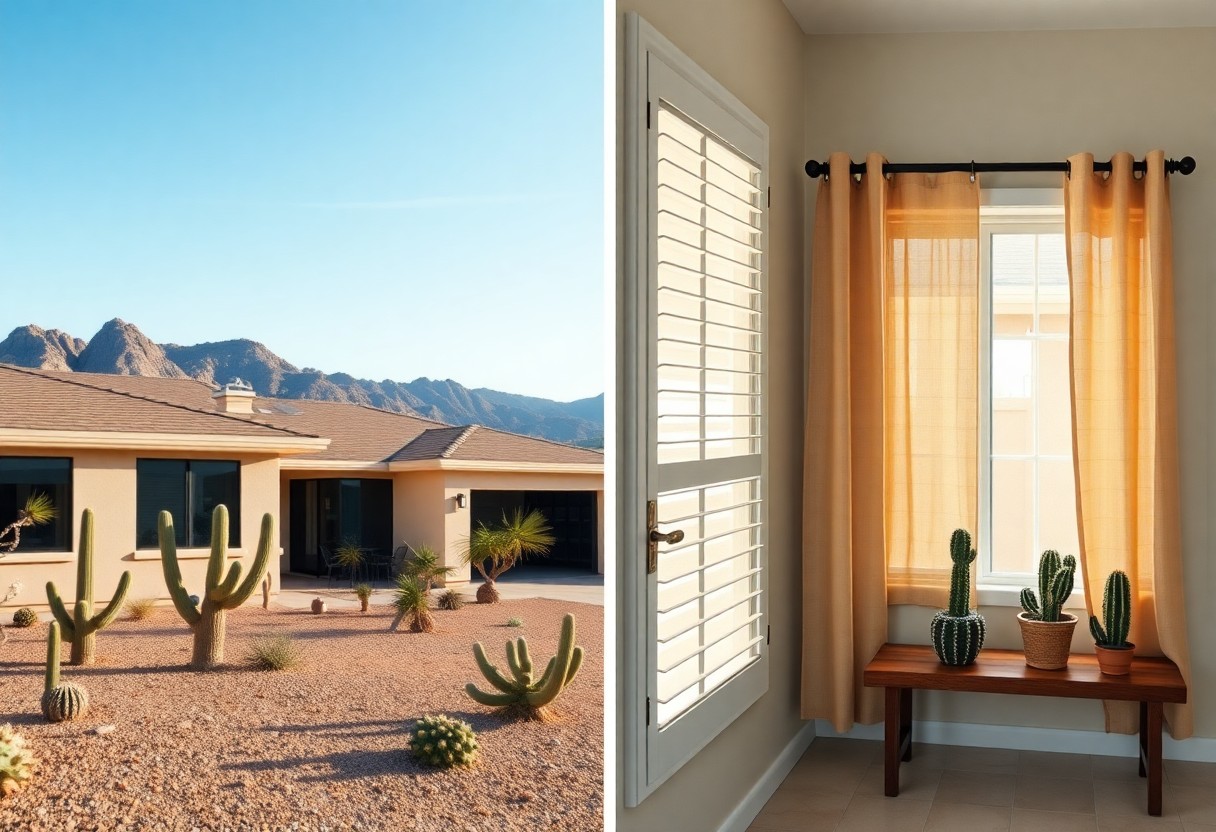
Overview of Window Treatments
You’ll find window treatments range from fabric draperies and cellular shades to wood shutters and solar screens, each offering different thermal, light, and privacy control. In Pinal County’s hot summers (average highs near 100-105°F), well-chosen treatments can cut solar heat gain 30-60% and reduce cooling costs by roughly 10-20%. You can also pair treatments with tinting for year-round comfort and measurable energy savings.
Benefits of Window Treatments
You gain precise light control, increased privacy, and UV protection – many fabrics block up to 99% of UV rays – while improving comfort. Treatments can reduce glare for workspaces and lower HVAC load, especially when combined with reflective linings or layered systems. You also get design flexibility to match interior aesthetics without compromising performance.
- Energy savings: cut cooling costs ~10-20%
- UV protection: many liners block up to 99% of UV
- Glare control: adjustable slats or blackout liners for media rooms
- Privacy and style: customize fabrics and hardware to suit rooms
- Any installation can be scaled to room size, performance needs, and budget
| Energy Savings | Reduces solar heat gain 30-60% |
| UV Protection | Fabrics/liners block up to 99% UV |
| Light Control | From sheer to blackout options |
| Privacy | Adjustable slats or full coverage |
| Insulation | Cellular shades add measurable R-value |
Types of Window Treatments
You can choose blinds, roller and cellular shades, roman shades, draperies, shutters, or solar screens depending on performance and style. Cellular (honeycomb) shades improve insulation for cooler nights, while solar screens and reflective roller shades excel at daytime heat control, blocking 60-80% of solar gain. Shutters and heavy drapes add durability and sound dampening for busy streets.
If you prioritize daytime heat reduction, solar screens and reflective roller shades typically deliver the best solar heat gain coefficients, often lowering gain 60-80% in direct sun. Alternatively, layered systems-cellular shade plus drapery-can cut seasonal HVAC use by 10-15% in mixed climates. You should also note maintenance: vinyl and aluminum screens are low-maintenance, while natural-wood shutters need periodic sealing in dry Arizona air.
- Blinds: adjustable light control, good for bedrooms and offices
- Cellular shades: insulation benefits, ideal for energy savings
- Solar screens/roller shades: best for daytime heat reduction
- Shutters/drapes: durable, add sound dampening and privacy
- Any combination can be tailored room-by-room to balance light, heat, and style
| Blinds | Adjustable light, moderate insulation |
| Cellular Shades | Improves R-value; good for insulation |
| Roller/Solar Shades | Blocks 60-80% solar gain; low profile |
| Shutters | Durable, adds resale value and privacy |
| Draperies | Design flexibility; liners add blackout/UV protection |
Factors to Consider for Pinal County Homes
Pinal County’s desert sun, seasonal storms and HOA rules should shape your choice: quantify glass area, orientation and nearby shading, compare upfront costs versus 5-25% summer cooling savings, and weigh privacy needs against preserving views; window films can cut solar heat gain up to 70% and block >99% UV, while treatments like cellular shades add insulation and light control. Thou, balance long‑term energy savings with aesthetics and maintenance when deciding between tint and treatments.
- Sun exposure and glass orientation
- Budget, payback period and installation cost
- Privacy, view retention and HOA restrictions
Climate Considerations
Pinal County averages 300+ sunny days and summer highs frequently over 100°F, so you must prioritize solar heat control and UV protection; films that reject up to 70% of solar heat and block >99% UV reduce interior fading and AC runtime, while insulating treatments-like cellular shades with R‑values up to ~4-help during cooler nights and monsoon dust events.
Aesthetic Preferences
You’ll decide how much view and natural light to keep: low‑glare or near‑clear low‑e films preserve sightlines with minimal tint, whereas darker films or full‑coverage shades create privacy and dramatic contrast; HOA rules and curb appeal often steer homeowners toward subtle films or internally mounted treatments.
For example, decorative frosted films mimic etched glass for bathrooms at roughly $2-6 per sq ft, near‑invisible low‑e films run about $8-12 per sq ft installed, and custom roller or cellular shades typically cost $100-400 per window-so you can match style goals with concrete price points and visual outcomes.
Energy Efficiency
Your energy gains come from reducing solar heat gain and improving window R‑values: window films commonly cut cooling loads enough to lower summer electricity by ~5-20% depending on glass area and film quality, while cellular shades can reduce winter heat loss and summer gain, yielding measurable HVAC runtime reductions in Pinal’s hot climate.
Consider payback examples: an average film installation at $8-12/ft² may return investment in 3-6 years on homes with high cooling use, whereas high‑performance shades priced $150-400 per window can pay back faster in rooms with large south/west glazing; calculate based on your utility rates and window square footage.
Cost Comparison
When weighing costs for Pinal County homes, you’ll find window tinting usually delivers lower per-square-foot pricing, while window treatments vary widely by style and customization. Expect film installations commonly in the $5-12 per sq ft range and full-home treatments anywhere from $50 to $800 per window depending on blinds, shades, or shutters. Energy savings, installation time, and replacement frequency will shift the true cost over the next decade.
Cost & Maintenance Snapshot
| Home Window Tinting | Window Treatments |
| Upfront cost: $5-12 per sq ft; typical 10-20 window home $500-2,500 | Upfront cost: $50-800 per window; whole-home $1,000-15,000 (budget to custom) |
| Energy reduction: 20-40% cooling load (high-performance film) | Energy reduction: 5-25% depending on material and fit |
| Lifespan: 10-15+ years (ceramic films longer) | Lifespan: 5-20+ years (shutters longest, fabrics shorter) |
| Maintenance: simple cleaning; rare reapplication | Maintenance: frequent cleaning, mechanical repairs, fabric replacement |
| Installation time: hours to a day for typical home | Installation time: hours to days; custom shutters longer |
Initial Installation Costs
You’ll typically pay $5-12 per square foot for quality window film, meaning a 200 sq ft glazed area runs roughly $1,000-2,400 installed; by contrast, mid-range cellular shades or blinds often cost $100-300 per window, and custom shutters can exceed $500-1,200 each. Labor for precise tinting is faster, so total upfront outlay for tinting is often lower for multi-window homes.
Long-Term Maintenance Costs
You can expect minimal routine expense with tinting – occasional cleaning and rare replacement – whereas treatments may require regular cleaning, motor repairs for automated shades, or fabric replacement; on average, plan for $20-200/year for treatment upkeep versus under $50/year for tint cleaning and care. Warranties commonly cover film bubbling for 5-15 years, reducing unexpected costs.
Digging deeper, film warranties often translate to a real-world lifespan of 10-15 years for dyed/metalized film and up to 20 years for premium ceramic; full re-tinting later will cost a comparable upfront fee ($500-3,000 for whole-home projects). Treatments show more variable long-term spend: fabric fading in Arizona sun may force panel replacement every 5-10 years ($100-600 per window), motorized shade repairs run $100-400, and slat replacements or refinishing shutters add intermittent bills. Given Pinal County’s intense sun, you’ll likely see tinting produce steadier, lower maintenance costs over time, while high-end treatments can retain value but demand higher ongoing spend.
Expert Recommendations
Practical Choices for Pinal County Homes
If you prioritize daytime glare control, pick 35-50% VLT ceramic film to cut glare while keeping views; if insulation is the goal, use cellular shades with R-values up to 3.0 to lower heat transfer. Factory films (e.g., 3M) block about 99% of UV and can reduce solar heat gain substantially; combining tint with insulated shades often reduces AC runtime 10-20%-one 2,000 sq ft Pinal install saw ~15% lower cooling use after both upgrades.
Customer Reviews and Experiences
Real homeowners’ feedback
Many Pinal County homeowners tell you that window tinting cut interior heat by about 8-12°F on hot afternoons, citing a Casa Grande case where a 2,200 sq ft home reduced A/C runtime by 20% and saved roughly $45 monthly; others mention plantation shutters lowering glare but costing $1,800-$3,500 for whole-house installs and needing more maintenance. You’ll find installers with 4.8-star averages and verified photos, and a few reviews note bubbling issues when film wasn’t properly prepared-so check warranties and installation timeframes like 1-2 days for typical tint jobs.
Summing up
Now you can weigh energy savings, UV protection, privacy, upkeep, and aesthetics when choosing between home window tinting and window treatments for Pinal County homes. Tinting gives year-round solar control with low maintenance and clearer views; treatments offer design flexibility and insulation but require cleaning and replacement. Consider your budget, desired light control, and long-term efficiency-choose the option that aligns best with your priorities and local climate demands.