
Most homeowners in Pinal County find that professional home window tinting significantly lowers cooling energy use and blocks up to 99% of harmful UV rays, so you save on electric bills while protecting furniture and skin; by reducing solar heat gain and glare, quality films help your HVAC run less and extend interior lifespan, and choosing the right tint for your windows ensures measurable energy savings and long-term UV protection for your home.
Understanding Home Window Tinting
What is Window Tinting?
You apply a thin polyester film coated with metal, ceramic, or sputtered layers to your glass to control solar energy, reduce glare, and block UV; high-quality films can block up to 99% of UV and lower solar heat gain by as much as 50-70% depending on film type and orientation, helping your HVAC run less and your furnishings last longer.
- Reduces glare for clearer screens and tasks.
- Blocks UV to protect skin and fabrics.
- Knowing proper film selection can cut cooling costs by 10-30% in hot climates like Pinal County.
| UV Rejection | Up to 99% |
| Solar Heat Rejection | ~40-70% (varies by film) |
| Visible Light Transmission (VLT) | 5%-70% options |
| Lifespan | 10-20 years with professional installation |
| Installed Cost | Approximately $3-8 per sq ft |
Types of Window Films
You’ll encounter several categories: solar-control metalized films for low cost and strong heat rejection, ceramic films that offer high IR rejection with minimal reflectivity, low-e films that improve insulation in winter, safety/security films that hold glass on impact, and decorative films for privacy and style; each type delivers different energy and UV benefits-ceramics often perform best overall.
- Solar-control: strong heat and glare reduction.
- Safety/security: 4-8 mil or thicker to resist impacts.
- Knowing ceramic films can reduce solar heat gain by 40-70% while keeping window clarity high.
| Solar-control (Metalized) | Good heat rejection, may reflect |
| Ceramic | High IR rejection, non-conductive |
| Low-e | Improves insulation, lowers U-factor |
| Safety/Security | Shatter-hold, 4-12 mil common |
| Decorative/Privacy | Frosted or patterned for style |
You should match film properties to window orientation and usage: south- and west-facing panes benefit most from high IR rejection films, east-facing gets glare control for mornings, and north-facing often needs only UV protection; installers often measure U-factor and SHGC change-projects in similar desert climates report 15-25% HVAC savings after whole-house upgrades with ceramic or low-e films.
- Choose high-IR ceramic for west-facing glass in Pinal County.
- Combine low-e on north windows to reduce winter heat loss.
- Knowing a full-house retrofit typically delivers faster payback than treating isolated rooms.
| Best Orientation | South/West benefit most |
| Typical HVAC Savings | 10%-30% (whole-house) |
| Common Film Thickness | 1.5-12 mil |
| Installation Time | Average single-family: 4-8 hours |
| Maintenance | Gentle cleaning after 30 days |
Energy Efficiency Benefits
Tinted windows reduce solar heat transmission, cutting peak cooling loads and smoothing indoor temperature swings. You can expect solar heat gain reductions in the range of about 50-90% depending on film type, which commonly translates to 10-30% lower cooling energy use in hot-summer areas like Pinal County where daytime highs often top 100°F. That reduces HVAC runtime, lowers compressor strain, and helps smaller systems maintain comfort with less cycling.
Reducing Heat Gain
By choosing films with low solar heat gain coefficient (SHGC) you block a large portion of infrared and visible solar energy before it enters rooms. Ceramic and spectrally selective films typically reject 60-80% of solar infrared while preserving daylight, so south- and west-facing glass stays significantly cooler; measured interior surface drops of 10-20°F during peak sun are common in field tests.
Lowering Energy Bills
Lower peak cooling demand produces measurable savings: many Arizona homes report 10-30% reductions in summer cooling consumption after film installation. With residential electricity around $0.12-$0.15 per kWh, that commonly equals roughly $150-$600 per year for average single-family homes, varying by home size, window area, and orientation.
For a quick estimate, if your home uses 6,000 kWh for cooling annually, a 20% reduction saves 1,200 kWh; at $0.13/kWh that’s about $156/year. Typical installation costs range $300-$1,200 depending on window area and film quality, yielding payback periods commonly between 2-8 years; investing in higher-performance ceramic or spectrally selective films often shortens payback by delivering larger rejection rates and preserving daylight, improving long-term ROI.
Protection from UV Damage
Your windows let in far more than daylight; untreated glass allows ultraviolet radiation that fades upholstery, wood floors, and artwork while increasing skin aging and cancer risk. By installing quality window film you cut UV transmission dramatically, preserving interior finishes and lowering long-term replacement costs-especially important in Pinal County’s strong sun exposure where materials degrade faster than in cooler climates.
Harmful Effects of UV Rays
UVA penetrates glass and drives chronic damage like textile fading and photoaging, while UVB contributes to sunburn and DNA damage linked to skin cancer. You’ll notice colors dulling within months on south- and west-facing rooms; for example, fabrics near windows can lose vibrancy noticeably within 1-3 years without protection, shortening the life of expensive furniture and window treatments.
How Tinting Mitigates Damage
High-quality window films typically block up to 99% of UVA and UVB, so you get museum-level protection for everyday spaces. Applying film reduces UV exposure to occupants and slows material degradation-studies and product specs from major manufacturers show UV transmission below 1% for many architectural films, translating into measurable preservation of fabrics and finishes.
Different technologies affect performance: dyed films are economical but less durable, metalized films add reflectivity and heat rejection, while ceramic films offer UV blocking without significant darkening and resist interference with electronics. You should match Visible Light Transmission (VLT) to room use-for living areas pick higher VLT for daylight, and for display cases or south windows choose low-UV/high-block films that preserve color and texture over decades.
Installation Process
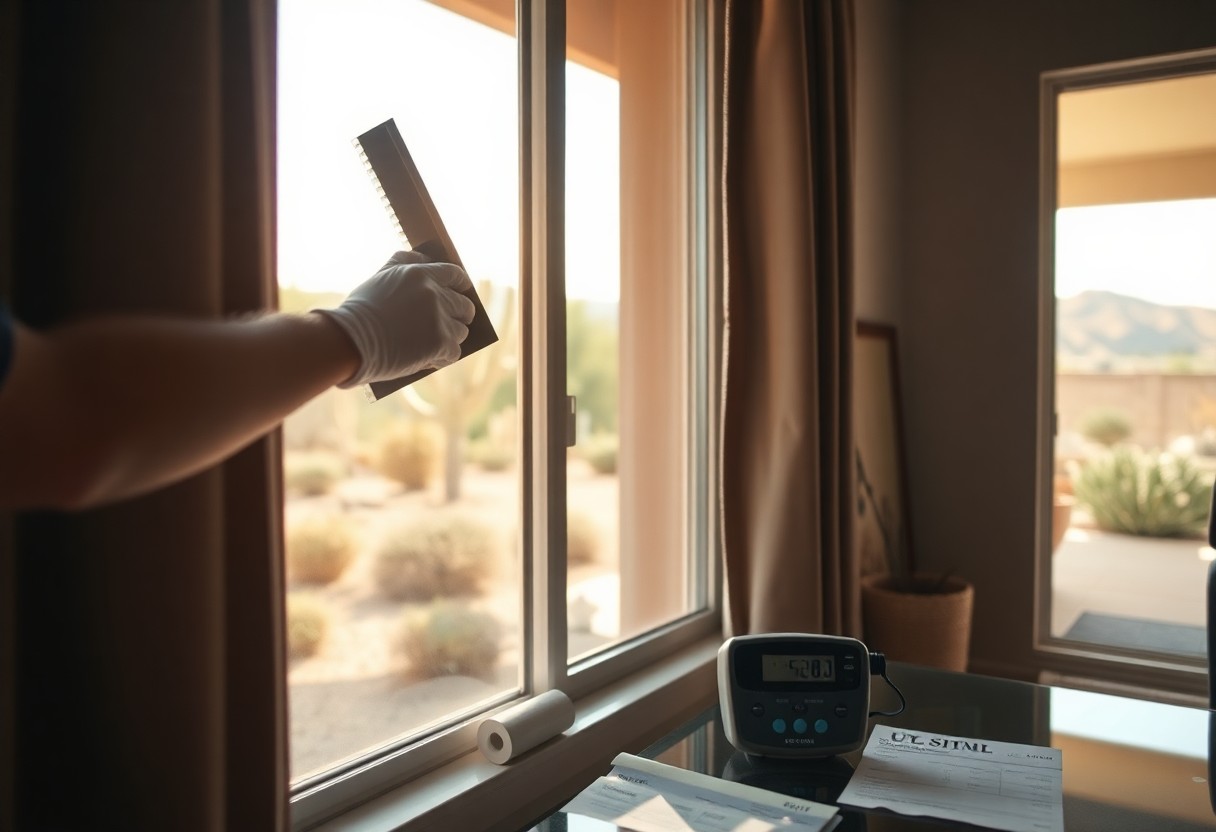
Installation begins with precise measurements and a thorough glass cleaning, then moves to cutting the film to size, applying a slip solution, squeegeeing out bubbles, and trimming edges; professionals typically let films cure 24-72 hours. You’ll see immediate reductions in glare and, with higher-performance films, up to 99% UV block and roughly 60-78% total solar energy rejection, which helps lower peak cooling loads in Pinal County’s sun.
Professional vs. DIY Installation
You’ll get faster, more consistent results from pros who can install 10-20 windows in 3-5 hours using heat guns, precision cutters, and warranty-backed films that maximize IR rejection. DIY kits run $30-$200 per window and may take 1-3 hours each, but you risk bubbles, miscuts, shorter film life, and voided manufacturer warranties if the surface prep or application is imperfect.
Cost Considerations
Expect DIY costs around $30-$200 per window, while professional installation typically ranges $8-$20 per sq ft; premium ceramic films cost $10-$25 per sq ft. For example, a 4’×5′ (20 sq ft) window can run roughly $160-$500 installed. You should weigh material grade, installer warranty, and projected solar-rejection performance when budgeting.
Think about payback: typical cooling bill reductions in hot, sunny regions are 10-25%, and films often last 10-15 years. If your average summer AC bill is $150/month and you save 15% (~$22.50/month), a $900 installation pays back in about 3.5 years. Also check local utility rebates or manufacturer promos that can lower upfront expense and improve ROI.
Local Regulations in Pinal County
Permits and Compliance
You typically won’t need a building permit for applying film to existing residential windows in Pinal County, but permits are required if you alter or replace glazing, change egress windows, or install laminated/tempered glass to meet code. You should confirm with Pinal County Development Services for commercial projects, historic districts, or multi-family buildings, and check HOA covenants that often restrict reflective or mirrored finishes.
Recommended Tint Levels
For most Arizona homes you should aim for 35-50% VLT to preserve daylight while cutting heat; films in that range often block 40-60% of solar heat and up to 99% of UV. For intense west-facing exposures consider 20-30% VLT or a low-SHGC (≤0.30) film to reduce afternoon cooling demand without darkening interior light excessively.
Match tint level to room use: bedrooms and media rooms benefit from 15-30% VLT for glare control, living areas and kitchens work well at 40-50% VLT, and spectrally selective films let you keep VLT higher (50-60%) while still rejecting 40-60% of solar heat. You should also verify that chosen films meet safety glazing standards (ANSI Z97.1/CPSC 16 CFR 1201) where code requires tempered or laminated glass, and run proposed options by your installer or county plan reviewer before purchase.
Choosing the Right Tint
Factors to Consider
You should balance heat rejection, visible light transmission (VLT), UV blocking and aesthetics when choosing film; ceramic films can cut solar heat gain 50-70% and block >99% UV, while dyed films cost less but may fade. Also check SHGC, U-factor and NFRC labels for energy performance and confirm manufacturer warranty terms. Knowing which metrics matter most will help you pick a film that matches your comfort and energy goals.
- VLT: 20-70% affects daylight and view retention
- Solar Heat Gain Reduction: 30-70% impacts cooling load
- UV rejection: look for >99% to prevent fading
- Material: ceramic vs metallic vs dyed-ceramic is best for stability
- Warranty: residential films often carry 10-15 years
Popular Brands and Products
You’ll encounter 3M Prestige, Llumar CTX, Huper Optik ceramic, Solar Gard and SunTek on most local supplier lists; 3M advertises up to ~60% solar heat rejection and >99% UV blocking, while Huper Optik emphasizes low reflectivity with stable VLT. Compare NFRC or manufacturer SHGC and VLT specs rather than price alone to assess true performance for your windows.
You can expect typical field reductions of 10-30% in cooling energy depending on film type and window orientation; ceramic films on south/west exposures often yield 15-20% AC savings and lower interior surface temperatures by 5-10°F. Local installers in Pinal County can run on-site measurements and provide NFRC-based estimates and warranty comparisons to finalize the best product for your home.
Conclusion
Conclusively, by installing high-performance window tinting in your Pinal County home you can lower cooling costs, stabilize indoor temperatures, and block up to 99% of harmful UV rays that fade furnishings and increase HVAC use; choosing professional-grade films tailored to local solar conditions ensures long-term energy savings, comfort, and protection for your family and belongings.