
There’s an effective way to increase your home’s privacy in Maricopa without blocking daylight: residential window tinting offers selective light transmission so you keep bright interiors while reducing visibility from outside. Choosing the right film improves UV protection, reduces glare and cooling costs, and preserves views; consult licensed installers to match tint level, warranty, and local codes so your windows perform safely and attractively.
Benefits of Residential Window Tint
Beyond aesthetics, window tint delivers measurable advantages for Maricopa homes: up to 99% UV blockage, 30-50% reduction in solar heat gain with high-performance films, and improved comfort that can cut cooling costs 10-20% during summer months. These performance gains protect interiors, enhance privacy, and reduce HVAC runtime without eliminating natural light.
Increased Privacy
When you install reflective, dual-reflective, or frosted films (commonly 15-30% visible light transmission), daytime visibility from outside drops dramatically while interior daylight remains usable. For street-facing rooms you can opt for one-way mirror effects or patterned privacy films; typical 1-5 mil thicknesses provide a durable barrier without significant optical distortion.
UV Protection
High-quality window film blocks up to 99% of UVA and UVB radiation, so you can protect furniture, flooring, and artwork from sun damage without darkening rooms significantly. You’ll often see slower fading on textiles and finishes, particularly for items within two feet of sunlit windows.
Ceramic and metallized films deliver that UV rejection while minimizing color shift and signal interference-ceramic options in particular block UV effectively without heavy reflectivity. Independent lab certifications (showing near-99% UV rejection) give you verifiable protection that far exceeds untreated glass and extends the life of interior finishes and valuables.
Energy Efficiency
By cutting solar heat gain 30-50% depending on film selection, tinting helps keep rooms cooler and can lower AC energy use 10-20% in hot climates like Maricopa. You’ll also reduce hot spots on west- and south-facing windows, improving thermostat stability and overall occupant comfort.
Low-e and spectrally selective films reject infrared heat while preserving visible light, so you can maintain brightness and reduce cooling load. Payback commonly occurs within 2-5 years based on electricity rates and window orientation, and pairing tint with external shading multiplies annual energy savings.
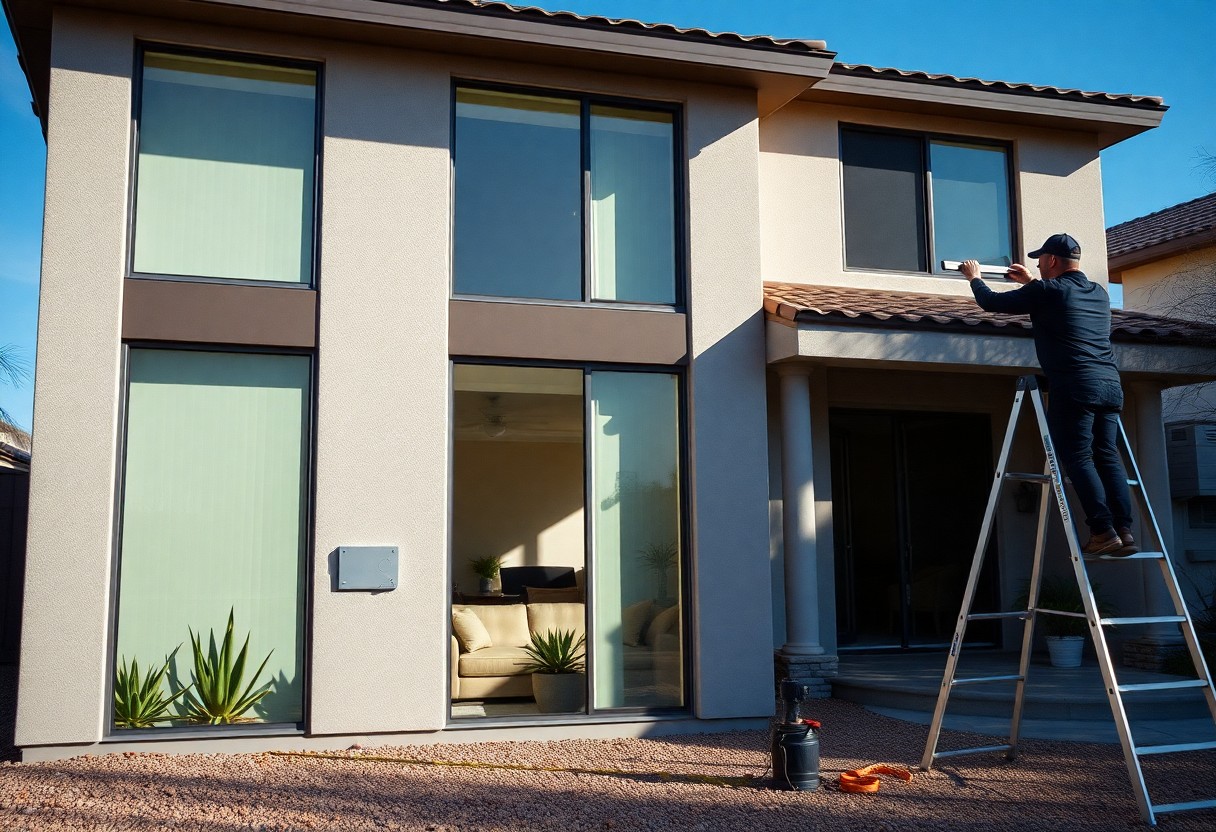
Types of Window Tint
You’ll encounter five common residential options-reflective, non-reflective (dyed/carbon/ceramic), ceramic, dyed, and metalized-each balancing privacy, visible light transmission (VLT), and solar heat rejection. Reflective films often reject up to 70% of solar heat and block 99% of UV; ceramic versions give high heat rejection with minimal reflectivity. Use reflective on west-facing rooms, ceramic where you want clear outward views, and dyed for budget-friendly glare control under 100 words.
| Reflective | High daytime privacy; up to ~70% solar heat rejection; reflective finish you can see from outside; best for west-facing windows |
| Non-Reflective | Maintains outward view; 30-60% heat rejection depending on film (dyed < carbon < ceramic); low exterior glare |
| Ceramic | High performance: 40-60% heat rejection, excellent UV blocking (~99%), no metal interference with signals |
| Dyed | Lowest cost; reduces glare and visible light; moderate heat rejection (20-40%); potential for faster fading |
| Metalized | Durable, high heat rejection, can interfere with electronics; noticeable mirror-like finish; good for durability |
- You can pair reflective films with light-colored interior shades to maximize daytime privacy while keeping natural light.
- You should expect varying warranties: dyed films often carry shorter warranties than ceramic or metalized options.
- After installation, schedule a 30-60 day inspection to confirm adhesion and edge sealing, especially in high-heat months.
Reflective Tint
You get strong daytime privacy and significant solar heat rejection with reflective tint-often around 50-70% heat rejection and up to 99% UV blockage-because of metalized layers that bounce infrared away. In Maricopa’s intense afternoon sun reflective films reduce cooling demand on west-facing rooms and cut glare for TVs and monitors, though they can produce a mirror-like exterior and may reduce nighttime outward visibility.
Non-Reflective Tint
You benefit from a subtle appearance with non-reflective tint, which preserves your outward view while lowering glare and solar gain; typical heat rejection ranges 30-60% depending on whether you choose dyed, carbon, or ceramic. This makes non-reflective films ideal for living rooms and bedrooms where you want daylight and privacy without a mirrored look.
You should differentiate between dyed, carbon, and ceramic non-reflective options: dyed is the most affordable but offers the least heat rejection and can fade over time; carbon adds durability and better heat control with a matte finish; ceramic provides top-tier heat rejection-often 40-60%-and blocks ~99% UV without metal, so it won’t interfere with Wi‑Fi or audio signals. For example, homeowners in single-story Maricopa homes who upgraded to ceramic non-reflective film reported noticeably cooler afternoons and reduced AC cycling, and many manufacturers back ceramic films with 10‑year to lifetime warranties.
Factors to Consider Before Tinting
Weigh how much daylight you want to keep against privacy and solar control; visible light transmission (VLT) ranges from about 5% (very dark) to 70%+ (nearly clear). Consider UV blocking-quality films often stop >99% of UV-and glazing type: low-E or double-pane can affect adhesion and performance. Factor installation cost ($6-$12/ft² installed for quality films) and warranty length. Assume that local climate, room use, and window size will guide your choice.
- Solar control: VLT choices and heat rejection (%)
- Privacy needs: one-way vs full privacy films
- Glass type: single-pane, double-pane, low‑E compatibility
- Budget & warranty: typical installed costs and 5-10 year warranties
- Installation quality: certified installers reduce bubbling and edge failure
Local Regulations
Check your HOA covenants and city rules before buying film; in Maricopa many homeowners associations require architectural committee approval for exterior appearance and may limit reflective finishes or dark VLTs. Historic districts and deed-restricted communities typically enforce stricter standards, and failure to get approval can lead to fines or forced removal. Obtain written approval and keep documentation of any permits or committee responses.
Aesthetic Preferences
Decide whether you want a neutral, color-stable look (ceramic/neutral films) or a mirrored/reflective finish for daytime one-way privacy; common VLT choices are ~70% (bright), ~40% (balanced), and ≤20% (high privacy). You should prioritize color fidelity in rooms where artwork or fabrics matter and match tint tone to frame and siding colors.
Order 12×12 or 24×24 samples and view them at morning, noon, and evening against your actual windows-larger panels reveal true reflectance and color shift. Coordinate tint tone with exterior materials and consider on-site mockups; many homeowners use ~40% ceramic on south-facing rooms for heat control while keeping bedrooms at ~70% to preserve morning light.
Installation Process
Installation begins with precise measurements and thorough glass cleaning, then you select a film size and trim it to within 1/8″ of the frame; application typically uses a wet method with a soap solution and a squeegee, followed by edge sealing and 24-72 hours curing depending on film type and ambient temp, with most single-pane residential windows taking 30-90 minutes each when handled by an experienced crew.
Professional vs. DIY
You’ll pay professionals roughly $5-$12 per square foot for materials, labor, and minor warranties, and they use heat guns, precision cutters, and edge sealants to avoid bubbles; DIY kits cost $25-$150 per window and can save money but often require 2-4 hours per window and risk miscuts, trapped debris, or voided glass warranties if you don’t have experience.
Maintenance Tips
After installation, wait 48-72 hours before cleaning to allow full adhesion; use a soft microfiber, non-ammonia cleaner or mild soapy water, and a squeegee, avoid razor blades or abrasive pads, inspect seals monthly for lifting, and keep indoor humidity below 60% to reduce bubble formation in high heat months.
- Clean with a 50/50 distilled water and mild dish soap solution for stubborn grime.
- Use a silicone-edge squeegee at a shallow angle to prevent streaks.
- Avoid ammonia, bleach, and sharp tools that can scratch or delaminate film.
- Perceiving early edge lift lets you address warranties or re-seal before moisture damage spreads.
For best longevity, you should schedule a professional inspection after the first 30 days to check edges and adhesion, and then every 6-12 months if you live in Maricopa where summer highs above 110°F can accelerate wear; small repairs-re-tucking edges or applying edge sealant-are often cheaper than full replacements, and documenting installation photos helps with warranty claims.
- Document installation date, film brand, and installer contact for warranty reference.
- Trim vegetation or window treatments that rub film and cause abrasion.
- Store window-cleaning tools separately to prevent cross-contamination of grit.
- Perceiving subtle hazing or UV fading early allows replacement before optical clarity worsens.
Cost Considerations
Costs vary by film type, window size, and labor, typically ranging from $6 to $20 per square foot for residential films in Maricopa. You should budget $300-$1,200 for a whole-house job on a typical single-story home with 10-20 windows. Warranties and professional installation add to upfront cost but often protect against bubbling or fading, tightening your long-term value and resale appeal.
Initial Investment
Initial costs split between film material and labor: basic dyed or metalized films run about $5-$8 per square foot, ceramic and high-performance films $12-$20 per square foot. You can save with DIY kits at $1-$4 per square foot, but expect longer installation time and higher risk of mistakes. Removal of existing film or specialty shapes can add $2-$6 per square foot or a service fee of $50-$150 per window.
Long-term Savings
High-performance films can cut solar heat gain by 40-70%, and you’ll typically see 10-25% reductions in cooling costs in hot climates like Maricopa. You’ll also reduce UV transmission by up to 99%, preventing fabric and wood fading; that preserves interior value and lowers replacement expenses. Energy savings plus extended HVAC life improve your payback timeline significantly.
If your cooling bills average $150 monthly ($1,800 yearly), a conservative 15% savings equals $270 per year; that makes a $900 installation pay for itself in roughly 3.3 years. You can shorten that with targeted tinting on west- and south-facing windows, which typically produce the highest solar load. Combining tint with attic insulation or smart thermostats often compounds savings, moving payback closer to 2-4 years depending on your usage patterns.
Frequently Asked Questions
Will tint block natural light?
How long does installation take?
Will tint affect my warranty or HVAC use?
You can expect UV blocking up to 99% and visible light transmission options from about 5-70%, so you retain daylight while cutting glare; you choose the VLT that fits each room. Installation typically takes 1-3 hours per room when done by a pro, and many films carry 10-15 year warranties. Heat rejection commonly ranges 40-70%; in a Maricopa retrofit, a living room dropped 6°F and A/C runtime fell about 12%.
To wrap up
Conclusively, residential window tint in Maricopa lets you increase privacy while preserving natural light, reduce glare and UV exposure, and lower cooling costs; by selecting the right film and professional installation you protect furnishings, maintain outward views, and enhance comfort without sacrificing the bright, airy feel of your home.